
Charles and Ray Eames: Designing for Modern Life

Charles and Ray Eames were among the most influential designers of the twentieth century. Their work included furniture, architecture, interiors, exhibitions, photography, toys and more than one hundred films. Rather than treating these fields as separate professions, they regarded them as different forms of the same activity: solving practical problems through research, experimentation and visual intelligence.
The name is correctly written Eames, and their work should be attributed to both partners. Charles was often the studio’s public representative, but Ray played an essential role in its spatial composition, colour, materials, graphics and final visual character.
Two Educations, One Design Practice
Charles Ormond Eames Jr. was born on 17 June 1907 in St Louis, Missouri. He studied architecture at Washington University in St Louis, although he left without completing the programme. He subsequently worked as an architect and became interested in the work of Frank Lloyd Wright and European modernism.
Ray-Bernice Alexandra Kaiser was born on 15 December 1912 in Sacramento, California. She studied painting in New York with the German-born artist Hans Hofmann and participated in the American abstract-art movement. Her training gave her a sophisticated understanding of colour, geometry, composition and the relationship between objects and space.
Charles and Ray met at the Cranbrook Academy of Art in Michigan, an important centre of American design directed by the Finnish architect Eliel Saarinen. Charles worked there with Eliel’s son, Eero Saarinen, while Ray assisted with drawings and presentation panels. Charles and Ray married in 1941 and moved to Los Angeles, where they established the Eames Office. They became partners in both life and work.
Their studio functioned less like a conventional architectural office and more like a laboratory. Designs were tested through models, full-scale prototypes, photographs and repeated physical experiments. A product was not considered complete merely because it looked elegant: it also had to work, withstand use and be capable of efficient production.
Moulded Plywood: Making a Hard Material Comfortable
The Eameses’ first major experiments concerned three-dimensionally moulded plywood. They wanted to bend laminated timber simultaneously in several directions, creating thin shells that followed the human body.
Working in the spare room of their Los Angeles apartment, they constructed a homemade moulding device—nicknamed the Kazam! Machine. During the Second World War, the technique was used to produce lightweight plywood leg splints for the United States Navy. The splint was not merely a military product: it provided valuable experience in moulding plywood into compound curves and manufacturing it in quantity.
These experiments led to the LCW—Lounge Chair Wood, developed in 1945–1946. Instead of forcing a single plywood sheet into an excessively complex form, Charles and Ray divided the chair into separate seat, backrest, legs and spine. The elements were joined with rubber shock mounts that permitted slight movement and prevented hard connections from transmitting every vibration through the structure.
The result was low, compact and anatomically shaped. Its comfort came primarily from geometry and flexibility rather than thick upholstery. The LCW demonstrated an important Eames principle: a chair could be industrially manufactured, visually expressive and responsive to the human body at the same time.
From Plywood to Fibreglass and Wire
The Eameses continued searching for a chair shell that could be mass-produced as a single three-dimensional surface. Their experiments produced the Moulded Fibreglass Chair, introduced around 1950. The organically curved shell could be combined with different bases: four metal legs, wooden dowel legs, a rocking base or a stackable structure.
This separation of shell and base created a flexible furniture system rather than a single immutable object. The same seat could be adapted for a dining room, school, office, auditorium or domestic interior. It anticipated the modular logic of contemporary industrial design.
Later versions were produced in moulded plastic. Environmentally problematic fibreglass production was suspended for a period, and manufacturers subsequently introduced alternative materials and improved processes. The chair’s continuing evolution demonstrates that industrial design is never completely separated from technological and environmental conditions.
Charles and Ray also developed chairs from welded steel wire. These reduced the seat to an open structural mesh: a three-dimensional surface made from lines rather than mass. As in Breuer’s tubular-steel furniture, the structure itself became the visual identity of the object.
The Eames Lounge Chair: Modern Comfort
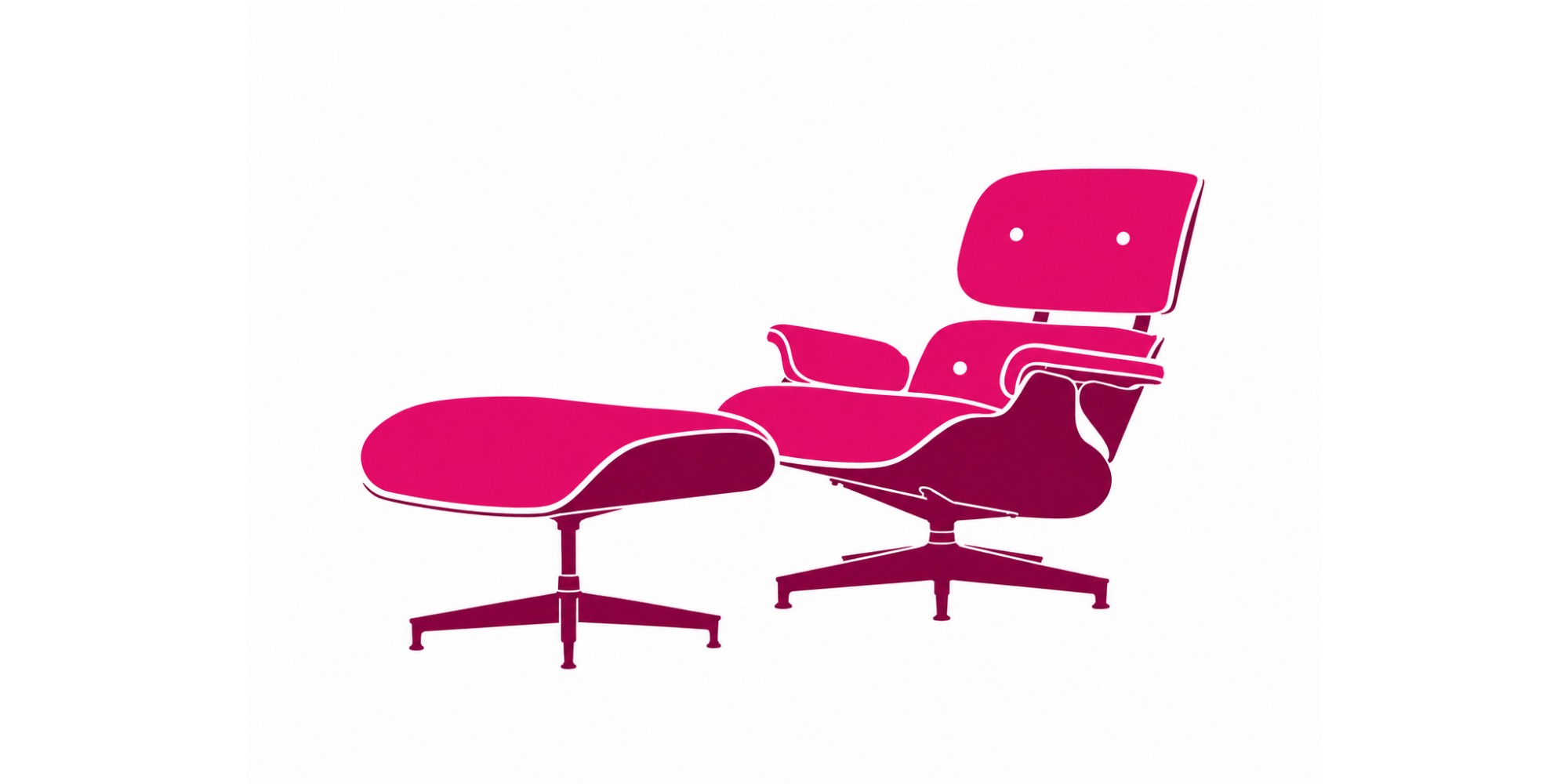
The Eames Lounge Chair and Ottoman, introduced in 1956, represented a different direction. Charles wanted it to possess the warm, welcoming character of a familiar baseball glove. The chair combined moulded plywood shells, leather cushions, cast aluminium elements and rubber shock mounts.
Unlike a conventional upholstered armchair, its cushions did not conceal a massive timber frame. The load-bearing shells remained visible, while the upholstery appeared as separate, replaceable components. The curved back and headrest supported a relaxed posture, and the ottoman extended the composition to include the legs.
The chair was conceived as a premium product rather than inexpensive mass furniture, but it applied the same research into moulded plywood, articulated components and industrial production that had shaped the earlier chairs. It became one of the most recognizable objects of post-war American design.
The Eames House: Furniture Principles Become Architecture
Charles and Ray’s best-known architectural work is their own home and studio, Case Study House No. 8, completed in Pacific Palisades, Los Angeles, in 1949. It formed part of the Arts & Architecture magazine programme investigating economical modern housing constructed with industrial materials.
The house consists of slender prefabricated steel frames filled with transparent, translucent and coloured panels. Instead of dominating its site, the linear building stands beside a meadow and among eucalyptus trees. Residence and studio occupy separate but related volumes.
The components were largely selected from industrial catalogues, and the steel frame was erected in approximately a day and a half. Yet the completed interior was anything but cold or mechanical. Textiles, plants, artworks, books, toys and objects collected during the couple’s travels created a dense and deeply personal environment. The house demonstrated that standardized construction and individual life were not opposites.
Beyond Furniture
The Eames Office also designed exhibitions and educational films. Their celebrated 1977 film Powers of Ten begins with a couple picnicking in Chicago, travels outward to the scale of the universe and then returns through the human body to the subatomic world. The film translated complex scientific relationships into a clear visual sequence.
Charles died on 21 August 1978. Ray continued organizing their archive and completing studio projects until her death exactly ten years later, on 21 August 1988. Their influence extends far beyond the recognizable silhouettes of their chairs.
Charles and Ray Eames demonstrated that modern design need not be sterile. Industrial materials could be combined with warmth, humour and human individuality. For them, design was not the decoration of an object after its engineering had been completed; it was the continuous process of understanding materials, production, use and experience.