
The Arc de Triomphe in Paris

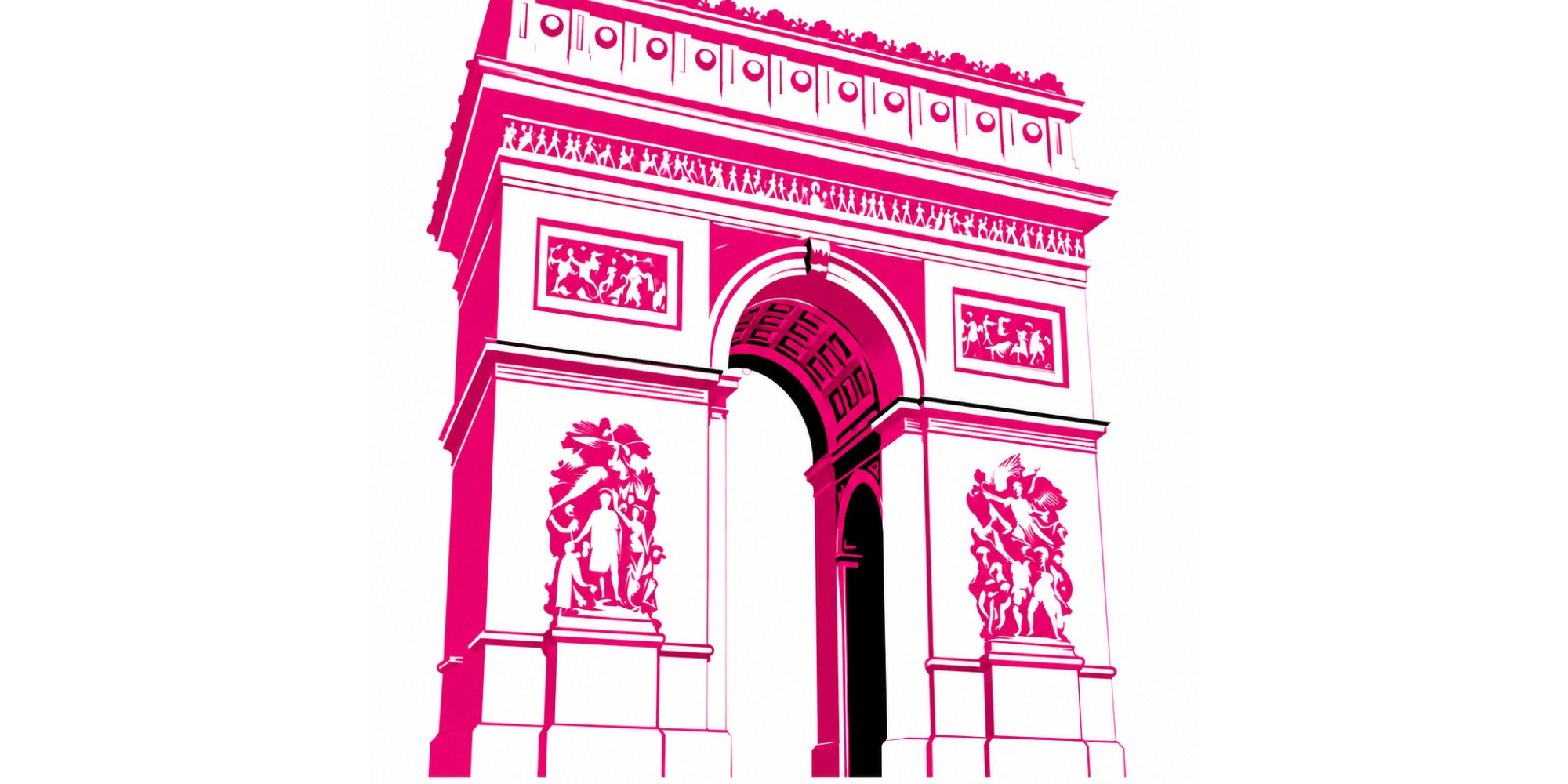
The Arc de Triomphe stands at the centre of Place Charles de Gaulle, formerly known as Place de l’Étoile, at the western end of the Champs-Élysées. It is one of the most recognizable monuments in Paris and an important symbol of French national history. Twelve avenues radiate from the square, creating a star-shaped urban composition that explains its former name, Étoile—“star.”
Napoleon Bonaparte commissioned the monument in 1806, shortly after his victory at the Battle of Austerlitz. It was intended to celebrate the achievements of the French armies and to provide a monumental entrance through which victorious troops could return to Paris. The original architect was Jean-François-Thérèse Chalgrin, who developed the project as an exceptionally large single-arched structure. Construction progressed slowly because of political change, financial difficulties and the fall of Napoleon. The Arc was finally completed in 1836, during the reign of King Louis-Philippe, approximately thirty years after work began.
Architecturally, the Arc de Triomphe belongs to French Neoclassicism. Its form was inspired by the triumphal arches of ancient Rome, particularly the Arch of Titus. However, Chalgrin simplified and monumentalized the Roman model. Instead of using classical columns as the principal decorative elements, he emphasized the enormous mass of the masonry, the clarity of the central opening and the powerful geometry of the façades. The monument is approximately 50 metres high, 45 metres wide and 22 metres deep. Its immense scale gives the structure an almost abstract architectural presence within the city.
The façades are enriched by sculptural groups commemorating military victories and significant moments in French history. The most famous is François Rude’s The Departure of the Volunteers of 1792, commonly known as La Marseillaise. Its dynamic figures contrast with the severe architectural frame. Other major compositions include The Triumph of 1810 by Jean-Pierre Cortot and Resistance and Peace by Antoine Étex. The names of French victories and military commanders are engraved on the inner and outer surfaces of the monument.
The Arc also occupies an essential position in the urban structure of Paris. It forms a central point of the Axe historique, the grand visual axis extending from the Louvre through the Tuileries Garden, Place de la Concorde and the Champs-Élysées toward La Défense. From its panoramic terrace, this geometry of avenues and monuments becomes especially clear.
Since 1921, the Tomb of the Unknown Soldier from the First World War has been located beneath the arch. An eternal flame, first lit in 1923, is rekindled every evening. This memorial transformed the Arc de Triomphe from a monument celebrating imperial military victory into a broader place of national remembrance. Today, the monument combines architecture, sculpture, urban planning and collective memory, representing both the ambitions of Napoleonic France and the complex history of the modern French nation.