
The Architecture of Sitting: From Four Legs to Cantilever and Kneeling Chairs

A chair is a small piece of architecture. It transfers the weight of the body to the floor, controls posture and determines how freely a person can move. Yet chairs are often judged primarily by appearance or familiarity. The conventional four-legged chair is commonly perceived as “normal,” while a chair without rear legs may seem unstable—even when its structure and ergonomics are more sophisticated.
Modern life makes this distinction important. Many people remain seated for hours while working, eating, travelling and relaxing. The human body, however, is not designed to maintain one fixed posture indefinitely. The principal ergonomic problem is therefore not the existence of four chair legs, but prolonged static sitting combined with unsuitable seat geometry and insufficient support.
What Actually Supports the Seated Body?
In a healthy upright sitting position, most body weight is transmitted through the two ischial tuberosities the “sitting bones” at the bottom of the pelvis not directly through the coccyx. Some load is also carried by the thighs, feet and backrest. The coccyx can become uncomfortable when the pelvis rolls backwards, the lower back collapses and the person sits in a slumped or excessively reclined position.
A rigid chair does not necessarily injure the spine, and a flexible chair is not automatically therapeutic. Comfort depends on several interconnected dimensions: seat height and depth, inclination, pressure distribution, lumbar support, upholstery and the relationship between the chair, desk and user’s body. If a seat is too deep, its front edge may press behind the knees; if it is too high, the feet cannot provide support; if it is too low, the hips and knees become excessively flexed. A poorly positioned screen or work surface can produce neck and shoulder discomfort even when the chair itself is well designed.
The body also needs movement. Remaining perfectly upright for hours is neither realistic nor desirable. Small changes of position redistribute pressure, activate different muscles and reduce the time for which any single tissue remains loaded. The best chair is therefore not one that forces the user into a supposedly perfect pose, but one that supports several good positions and makes transitions between them easy.
The Four-Legged Chair: Stable but Often Static
The traditional four-legged chair is structurally efficient. Four separate supports produce a stable platform using wood, metal or plastic, and the form can be manufactured inexpensively. Its weakness is not the number of legs but the fact that many models are completely rigid and non-adjustable.
A flat wooden seat with a vertical back may be entirely suitable for a short meal or meeting. It becomes less appropriate for an eight-hour working day. Adding excessive padding does not necessarily solve the problem: very soft upholstery can allow the pelvis to sink unevenly, while thick foam may restrict movement and retain heat.
For prolonged work, a conventional chair performs better when it has an appropriately shaped seat, a rounded front edge, effective lumbar support and dimensions matched to the user. Armrests should support the forearms without lifting the shoulders. The feet should rest firmly on the floor or on a footrest. Even then, regular changes of posture and short periods of standing or walking remain essential.
The Cantilever Chair: Structure as a Spring
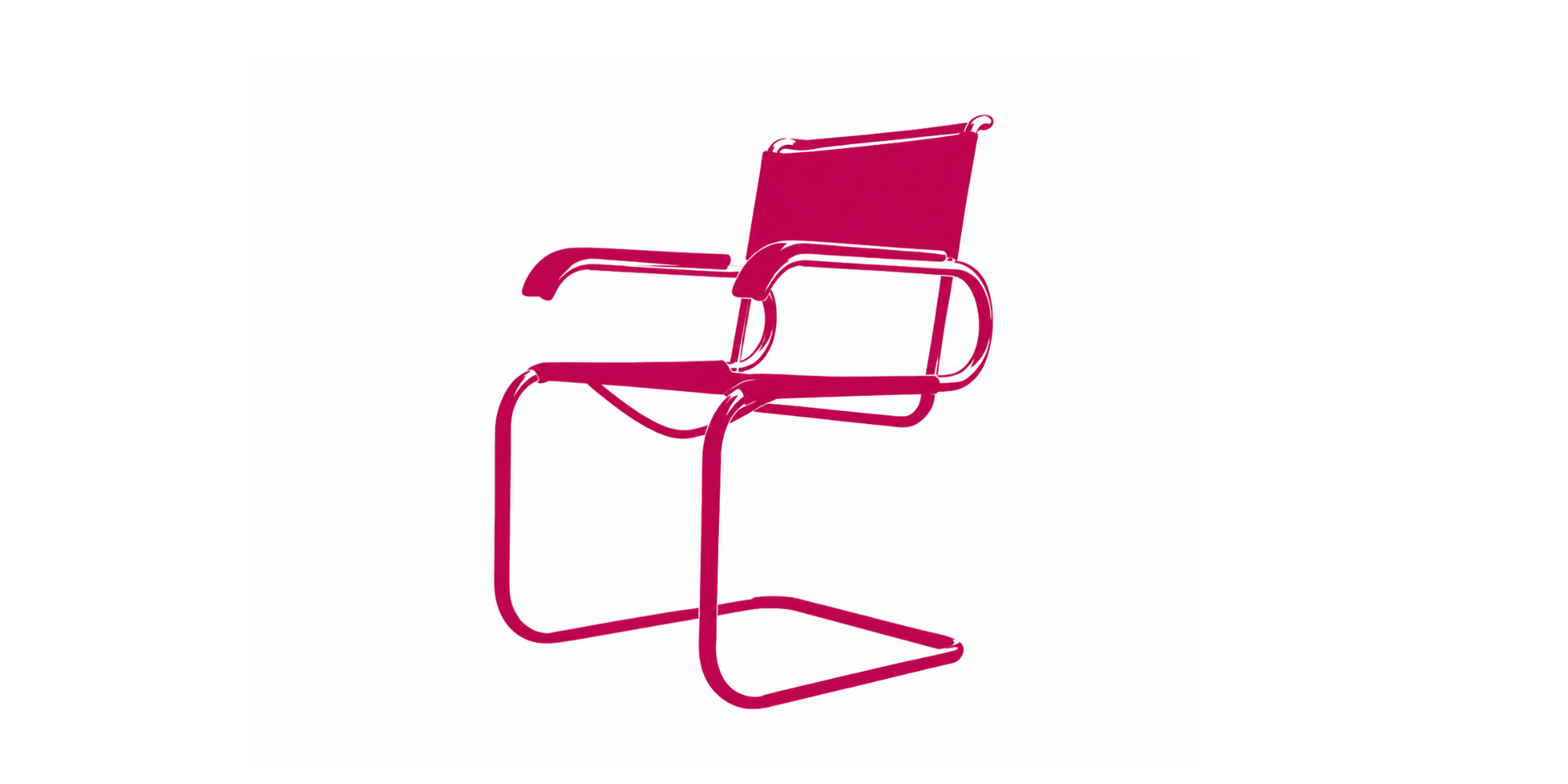
The cantilever chair eliminates the two rear legs. Its seat is supported by a continuous frame that bends down at the front and extends backwards along the floor. The structure works partly as a spring: when the user sits or shifts position, the metal frame can flex slightly instead of behaving as an entirely rigid platform.
The idea emerged from the experiments of European modernism. Mart Stam produced early prototypes in 1926 using lengths of gas pipe connected by elbow joints. Mies van der Rohe soon developed a more elastic version, while Marcel Breuer transformed the principle into the celebrated B32 or Cesca chair. These designs made the new possibilities of tubular steel visible: the chair appeared to float above the floor, supported by a single continuous line rather than four isolated legs. Vitra Design Museum
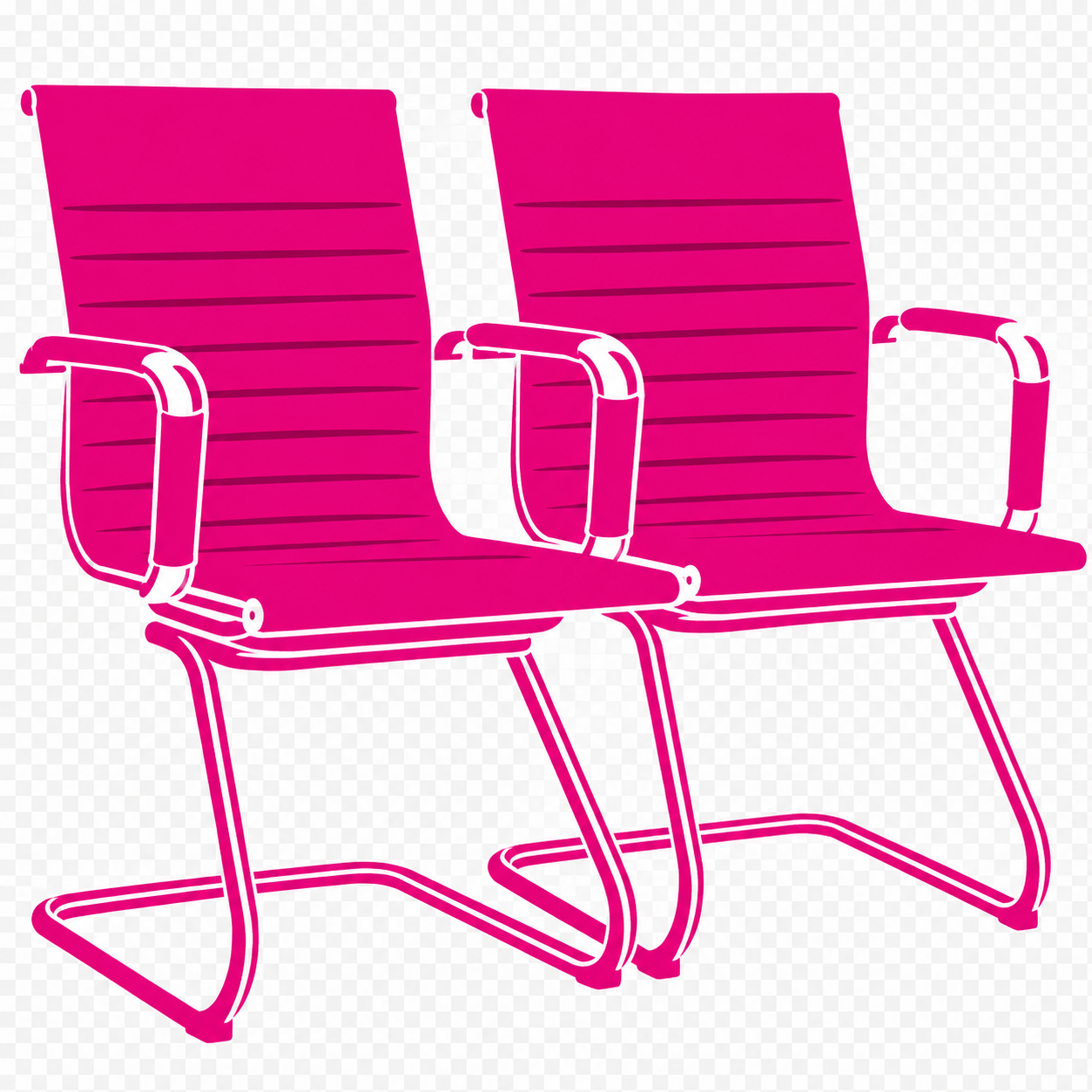
The black chairs in the first photograph belong to this cantilever family. Their chrome-plated tubular frames act as sled bases and support the seat from the front. The suspended seat and back may contribute additional flexibility. When properly engineered, this construction produces a gentle yielding sensation as the user sits down, leans back or changes position. It can soften abrupt loading and make the chair feel less static.
However, the absence of rear legs does not by itself remove pressure from the spine. The useful effect comes from controlled flexibility, adequate seat geometry and pressure distribution. A thick or poorly proportioned steel tube may be almost rigid, while excessive flexibility can make a chair unstable or tiring. The frame must also resist repeated cyclic loading without permanent deformation or failure at its joints.
Cantilever chairs offer practical advantages in interiors. Their open structure creates visual lightness, simplifies cleaning and reduces the number of contact points on the floor. They work especially well in conference rooms, reception areas and dining spaces, where people sit for moderate periods and appreciate a small degree of movement. Nevertheless, most models lack the adjustability required for prolonged individual computer work. A beautiful cantilever chair should therefore be selected according to its intended duration of use, not only its silhouette.
The So-Called “Japanese” or Kneeling Chair
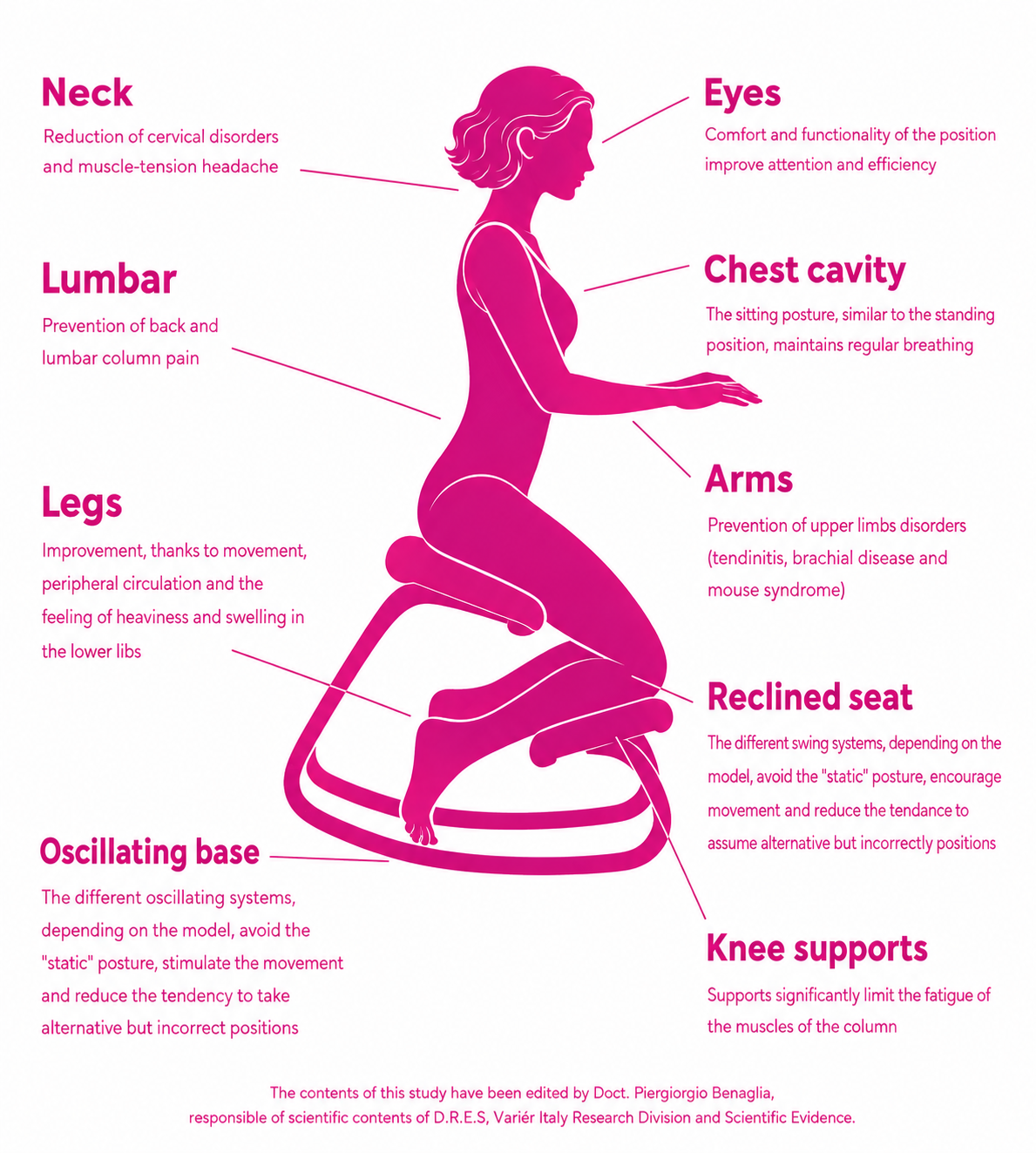
The chair in the second image is commonly called a kneeling chair, although the modern version is Scandinavian rather than Japanese. Its posture may recall the Japanese seiza position, but the best-known rocking model—Peter Opsvik’s Variable Balans—was designed in Norway in 1979. Its laminated wooden runners, inclined seat and padded shin supports form one continuous dynamic system.
The inclined seat encourages the pelvis to rotate slightly forwards and opens the angle between the torso and thighs. This may help some users preserve lumbar curvature more effectively than on a horizontal seat. Small studies found that an ergonomically designed kneeling chair with an approximately 20-degree seat inclination maintained lumbar curvature closer to standing posture, although the authors emphasized that further research was required. 2008 study A later pilot study likewise found a smaller reduction of lumbar lordosis than with the participants’ usual chairs.
Despite its name, the knees should not carry the body’s full weight: the user remains seated on the pelvis, while the padded supports contact principally the shins. Curved runners permit gentle rocking and frequent changes of position. Nevertheless, this chair is not a universal medical solution. It can produce pressure or fatigue in the shins, knees and ankles, offers little conventional back support and may be difficult to enter or leave for people with limited mobility. Claims that it prevents every neck, circulatory or upper-limb disorder exceed the available evidence. It is most useful as one of several seating options rather than a posture to be maintained all day.
Designing an Interior for Movement
A well-designed workplace should not search for a single miraculous chair. It should create an environment in which movement occurs naturally. An adjustable task chair may be used for concentrated computer work, a cantilever chair for meetings, and a kneeling or rocking chair for shorter periods of active sitting. A sit–stand desk provides another position, but standing motionless for hours merely replaces one static posture with another.
When selecting chairs, designers should consider:
the duration and purpose of sitting;
the user’s height, proportions and mobility;
seat height, depth, inclination and front-edge shape;
lumbar and forearm support;
controlled flexibility rather than softness alone;
compatibility with the desk, screen and floor;
stability, durability and ease of standing up;
opportunities to change position frequently.
Beauty in furniture is not simply familiarity. The four-legged chair remains useful because it is stable, economical and versatile. The cantilever chair demonstrates how structural elasticity can create comfort and visual lightness. The kneeling chair explores a different relationship between the pelvis, legs and working surface. None is inherently perfect or harmful: their value depends on geometry, materials, construction, duration of use and the individual body.
The healthiest chair is ultimately the one that supports the body without trapping it—and reminds its occupant, through comfort and freedom of movement, not to remain seated in exactly the same way for too long.