
Thutmose: The Artist Who Crossed the Abyss

For nearly three thousand years, Egyptian art obeyed one of the most stable visual systems ever created. Its rigidity was not caused by a lack of artistic ability. On the contrary, Egyptian craftsmen possessed extraordinary technical mastery. But art was not understood primarily as individual expression: it served religion, royal authority and the preservation of cosmic order.
The pharaoh stood at the summit of a strictly organised hierarchy, followed by priests, officials, scribes and artisans. Temples and royal workshops determined what could be represented and how. The scale of a figure indicated rank rather than physical size. The head and legs were generally shown in profile, while the eye and shoulders faced the viewer. The body was assembled from its most recognisable parts according to a proportional grid. Statues were frontal, symmetrical and composed, their poses designed to suggest permanence rather than movement. Images were not merely decorative: they were believed to participate in the reality they represented. Consequently, deviation from the accepted canon could acquire not only an aesthetic but also a religious and political meaning.
Yet no canon, however powerful, can remain untouched by time. During the reign of Amenhotep IV—better known as Akhenaten—the apparently impassable boundary of Egyptian tradition was suddenly crossed. The sculptor Thutmose became one of the greatest representatives of this transformation. He did not simply step beyond the old convention: metaphorically, he leapt across the abyss separating the anonymous servant of a system from the recognisable creative individual.
A Revolution from the Throne
The transformation began not as a rebellion by independent artists but as a revolution imposed from above. This distinction is essential. Akhenaten did not liberate art from state patronage in the modern sense; he replaced one official religious and artistic doctrine with another. Nevertheless, by destroying the authority of the old canon, his reform opened a space in which unprecedented experimentation became possible.
Amenhotep IV inherited the throne of a wealthy and powerful New Kingdom empire in the fourteenth century BCE. At that time the priesthood of Amun at Thebes controlled enormous estates, workshops and economic resources. The growing power of the temple establishment could compete with royal authority. The young pharaoh gradually elevated Aten—the visible solar disk—above the traditional gods. He changed his name from Amenhotep, “Amun is satisfied,” to Akhenaten, commonly interpreted as “Effective for Aten.” He founded a new capital, Akhetaten, the “Horizon of Aten,” at present-day Amarna, and eventually launched severe measures against Amun’s cult and name. Thus, it was Amun who was rejected, not Aten, and Aten who became the supreme focus of royal worship. Whether this system should be called strict monotheism, monolatry or an exclusive royal cult remains debated.
Politically, the reform strengthened the direct relationship between the king and the divine. Aten’s rays reached the world through Akhenaten and Nefertiti; access to the god was still mediated by the royal family. Old temples lost influence, while a new capital, priesthood and artistic programme arose around the court. Egypt remained powerful, but diplomatic correspondence suggests increasing difficulties abroad, particularly in Syria and Canaan. After Akhenaten’s death, the experiment rapidly collapsed. Tutankhamun restored the traditional gods, the court abandoned Akhetaten, and later rulers attempted to erase the Amarna kings from official history. The revolution was brief—Akhenaten reigned for approximately seventeen years—but its artistic consequences were remarkable.
When the Canon Began to Move
The early art of Akhenaten’s reign overturned the traditional image of the eternal, physically perfect pharaoh. The king appeared with an elongated head, narrow eyes, projecting chin, long neck, heavy hips, rounded abdomen and slender limbs. These characteristics should not automatically be interpreted as medical symptoms or literal portraiture. They formed a new ideological language, perhaps combining masculine and feminine qualities to express the creative totality of the solar deity.
More important than anatomical exaggeration was the discovery of movement, intimacy and time. Akhenaten and Nefertiti were shown holding and kissing their children. Princesses sat on their parents’ laps. Bodies bent, touched and responded to one another. Garments followed the contours of the body, while faces acquired age, tension and individual character. The royal family was still sacred, but it was no longer represented exclusively as frozen and inaccessible.
Relief and sculpture became experimental fields. Lines grew more fluid; heads turned; bodies stretched and gestures softened. The artist was invited—indeed ordered—to abandon one inherited canon and invent another. Amarna art therefore presents a paradox: political and religious absolutism produced one of the most radical stylistic ruptures in ancient history. Art was not yet free from power, but it had discovered that seemingly eternal rules could be broken.
Thutmose: The Man Emerging from Anonymity
Very little is known about Thutmose as a private person. He lived and worked at Akhetaten during the later years of Akhenaten’s reign, around 1350–1330 BCE. Archaeological evidence identifies him as a leading sculptor, conventionally called the king’s or court’s master sculptor. His name and title survived in association with a workshop complex excavated at Amarna in 1912 by the German expedition led by Ludwig Borchardt.
The workshop contained unfinished statues, portrait studies, plaster masks, tools, pigments and models representing members of the royal family and other individuals. Together, these objects reveal not only finished art but also the process behind it: observation, casting, measurement, modelling, correction and repetition. Some plaster studies appear astonishingly direct, preserving wrinkles, asymmetries and distinct facial structures. They bring us face to face with real individuals rather than timeless types.
Thutmose was almost certainly not working alone. Like other masters, he supervised a workshop of assistants and apprentices. Nor can every object discovered there be confidently attributed to his own hands. Nevertheless, the survival of his name is extraordinary. Most Egyptian painters and sculptors remained anonymous to later history, even when their technical achievements were exceptional. Thutmose is one of the comparatively few whose personal identity emerged from behind the collective institution of the royal workshop.
This emergence of the named artist has great symbolic importance. The old system presented artistic creation as the execution of an eternal order. In Thutmose’s workshop, however, we can sense decision, experiment and individual judgement. He worked within a state programme, but he was not merely a passive instrument. His portraits demonstrate a mind selecting, refining and transforming what the eye observed.
Nefertiti: Beyond the Beauty of the Queen
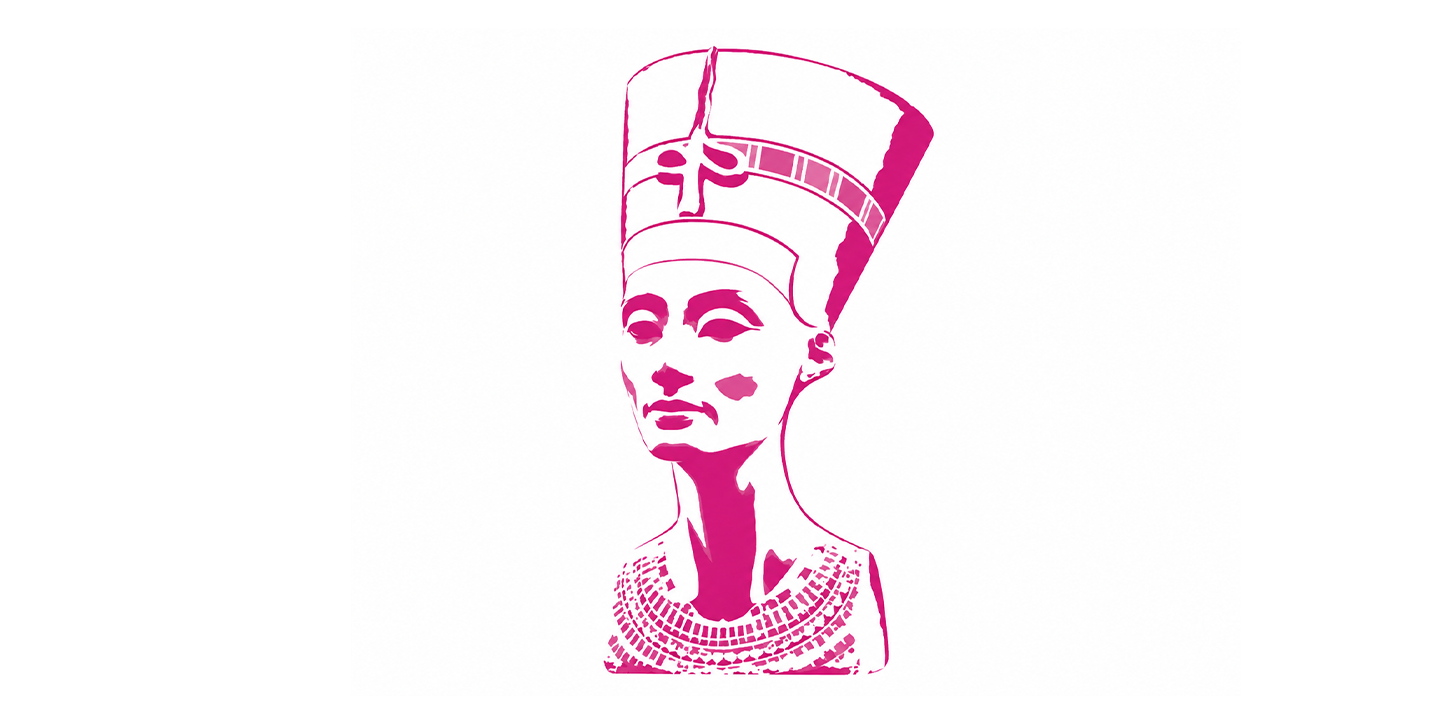
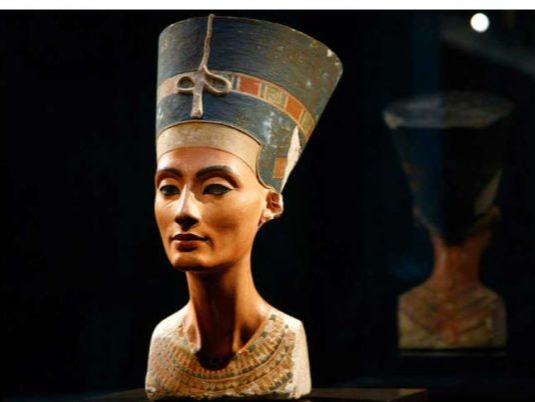
The painted bust of Nefertiti, created around 1340 BCE and discovered in Thutmose’s workshop, is among the supreme achievements of ancient sculpture. Its importance does not depend on whether Nefertiti herself was beautiful. The work must be judged first as an act of artistic intelligence.
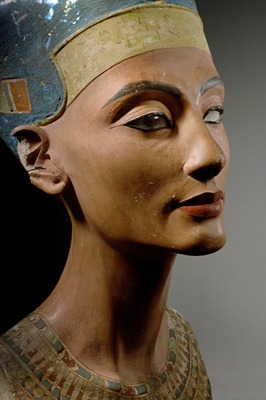
The bust has a limestone core, refined with layers of gypsum stucco that allowed the sculptor to model the face and crown with exceptional precision. Colour was not added as a secondary decoration; it completed the sculptural conception. Warm skin tones contrast with the deep blue crown, the multicoloured collar and the sharply defined eyebrows and eyelids. One eye contains an inlay of crystal and dark wax, while the other was left without its inlay. This and other evidence suggests that the bust may have served as a workshop model rather than a completed object intended for public display.
The work’s mastery lies in the tension between geometry and life. The tall crown establishes a powerful vertical axis. The long neck is almost architectonic, supporting the head like a slender column. The face appears symmetrical at first glance, yet subtle differences around the eyes, cheeks and mouth prevent it from becoming mechanical. Fine folds beneath the eyes and slight hollows in the cheeks suggest maturity rather than an abstract, ageless ideal.
Here Thutmose did not merely reproduce a woman’s appearance. He balanced royal typology, natural observation and formal idealisation. The bust is both an official image and a penetrating portrait, both symbol and individual. It occupies the precise point at which the Egyptian canon opens and a living personality appears through it.
Amarna sculpture did not entirely abandon convention, nor did round sculpture begin with Thutmose. Egypt had produced magnificent three-dimensional works for many centuries. But in his workshop, Egyptian portrait sculpture reached an exceptional synthesis of technical refinement, psychological presence, colour and individual character. The Nefertiti bust is therefore not simply a representation of legendary beauty; it is evidence of how profoundly an artist could understand material, proportion and human presence.
The Creative Spirit Cannot Be Erased
The Amarna revolution was defeated politically. The temples of Amun reopened, the old religious order returned, and Akhetaten was abandoned. Much of its imagery was destroyed or reused. Official memory attempted to remove Akhenaten and his world from history.
Yet it failed to erase Thutmose.
His workshop survived beneath the ruins, and with it survived the name of an artist. This gives his story a meaning that reaches far beyond Egypt. Institutions can regulate art, governments can commission it, priesthoods can define its subjects, and academies can establish proportions and rules. A new authority may even replace one canon with another. But no system can completely extinguish the human impulse to observe, invent and create.
Art does not always escape power through open revolt. Sometimes it breaks its chains from inside the official workshop, through a more truthful line, a more sensitive surface or a face that refuses to remain merely a symbol. Thutmose crossed that boundary. He transformed a state commission into an enduring revelation of individual presence.
The political revolution of Akhenaten lasted less than a generation. The creative act of Thutmose has lasted more than three thousand years.